Back to Matcha Guide

How to play.

Matcha is meant to be picked up, not studied. Here is the whole thing in a few minutes — a pack, some chords, a loop, a video. No theory needed.

01First loop

Your first loop 前奏

The short path from opening the app to something you can share:

  1. Choose a pack — a mood to play in. Tokyo Rain is an easy place to start.
  2. Tap the big chord buttons. The keyboard picks the root; the buttons pick the colour.
  3. Press play. Drums and bass come in, and your four chords loop.
  4. Jam over the loop. When you want to keep or arrange what you played, that is Studio.

That is the entire loop. Everything below is just the same four moves, in more detail.

The app also walks you through this on the real screen the first time you open it — four short pointers at the keyboard, the chord controls and the two Studio features. You can re-run it any time from Settings.

02Packs

Pick a mood 気分

A pack is a complete kit — synth, bass, drums, swing, tempo, chord palette and colour, chosen to sit together. Eight come with the app: Tokyo Rain, Study Session, Sunset Drive, Midnight Jazz, Rainy Cafe, Neon Sleep, Saturday Cartoon and Late Bus.

Four more — Rainy Taipei, Dusty Cassette, Bedroom R&B and Night Train — are Signature Packs, part of Studio. You can open any of them and hear it play before you decide.

To switch, tap PACK in the row above the transport and choose another. The whole instrument follows — you can change it whenever, and it never loses your place.
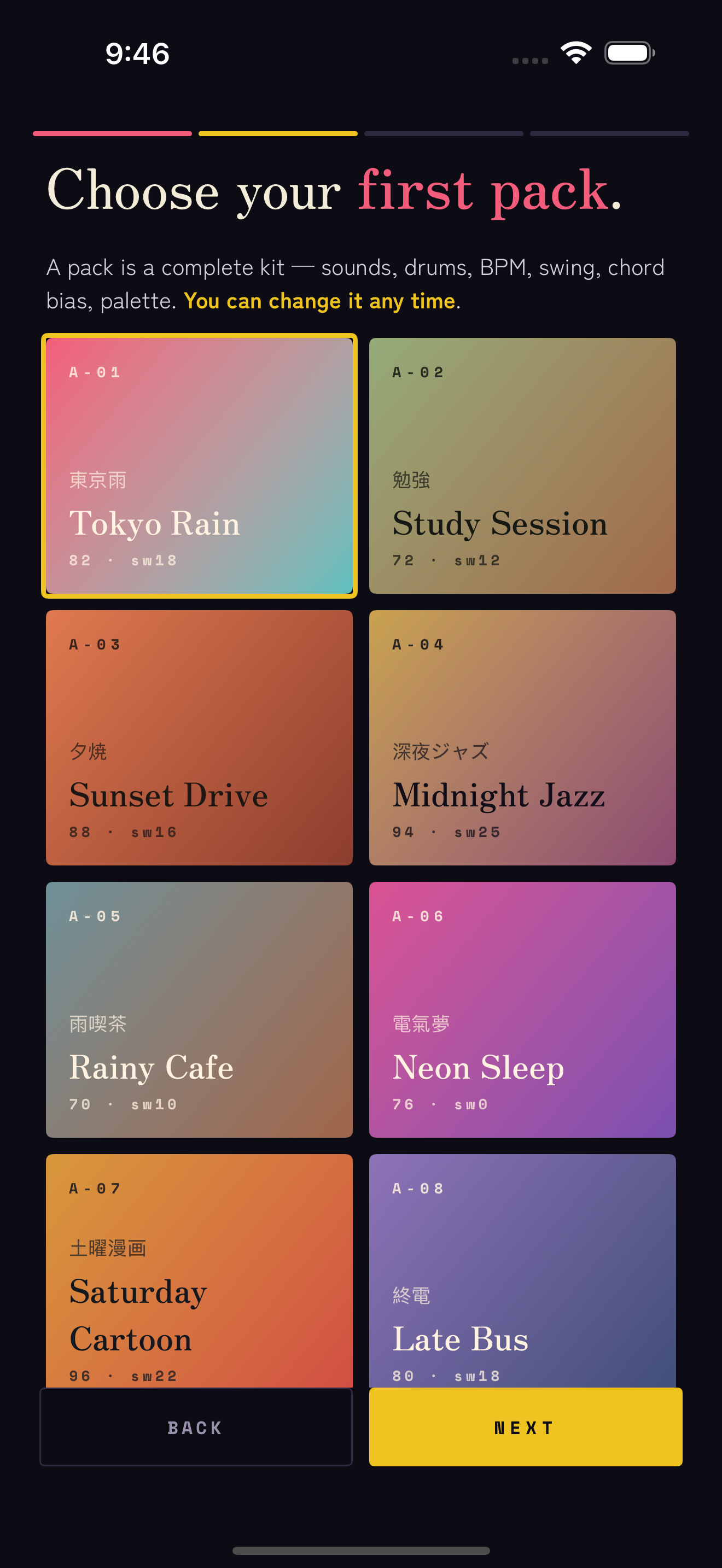
The pack picker — the eight mood packs as coloured tiles
Eight packs to start with
03Chords

Play by feel 和音

Every chord is three small choices working together:

  • The keyboard sets the root. Press A, and you are playing an A chord.
  • The top row sets the typedim min maj sus.
  • The bottom row adds a colour6 m7 M7 9.

So A with min and m7 gives you Am7. Change any of the three and the chord updates as it plays. Voice-leading is built in, so moving from one chord to the next stays smooth on its own.

The slider above the buttons is the voicing — drag it to open the chord up or draw it in tighter.
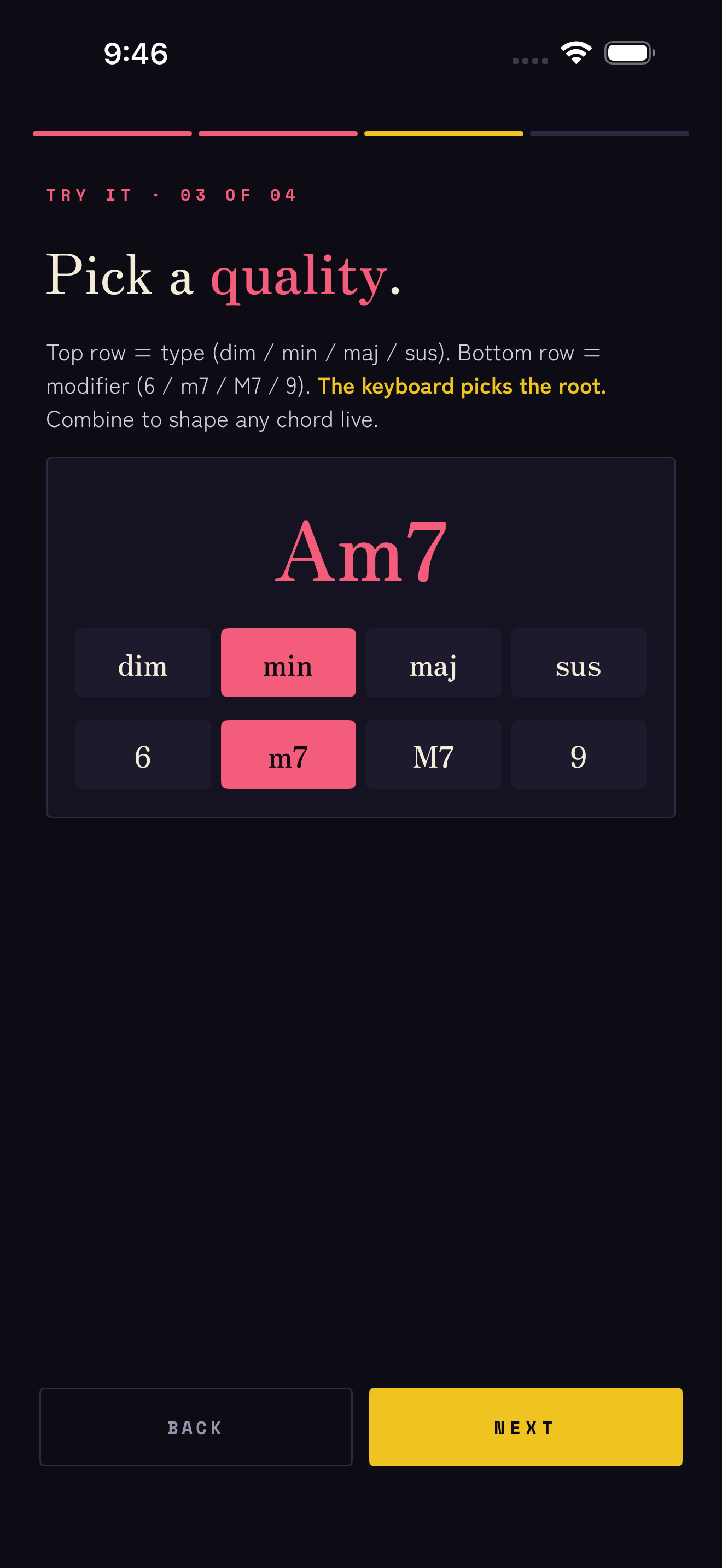
The chord grid — type on the top row, colour on the bottom, showing Am7
Type + colour = the chord
A note

You do not need to read music. If a change sounds good, it is good — that is the whole idea.

04Keyboard

The keyboard leads 鍵盤

One octave, C to B — two on iPad. As a chord sounds, its notes light up, so you can always see what you are playing.

The keyboard also sets the register: press low for a warm, rounded voicing; press high for a brighter one. It is a feel control as much as a way to choose the root — the same chord can sit deep or float, depending on where you touch.

05Sound

Shape the tone 音色

Five tabs sit just above the transport. Tap any one to open its controls:

  • Sound — the lead voice: Rhodes, Pad, Bell or Organ. An experimental sampler can be switched on in Settings.
  • Bass — Root, Walking, Octave, 5th, 3rd, Arp, or Silent when you want none.
  • Drum — Boom Bap, Jazz, Lofi or Dilla, with swing and level to taste.
  • FX — reverb and chorus to set the room, and tone to soften the top end.

Start from a pack you like and nudge one thing at a time. Small moves go a long way here.

06Record

Catch four bars 録音

Recording is part of Studio — playing, the packs and live MIDI are free; keeping what you played is the paid half. Once it is unlocked:

  1. Press play. The drums and bass join, and your four chords begin to loop.
  2. Play along — change chords, drag the voicing, find something you like.
  3. Tap the red circle. Matcha records your next four bars as they play.
  4. Tap it again to stop. The bar count and tempo sit to the right of the transport.
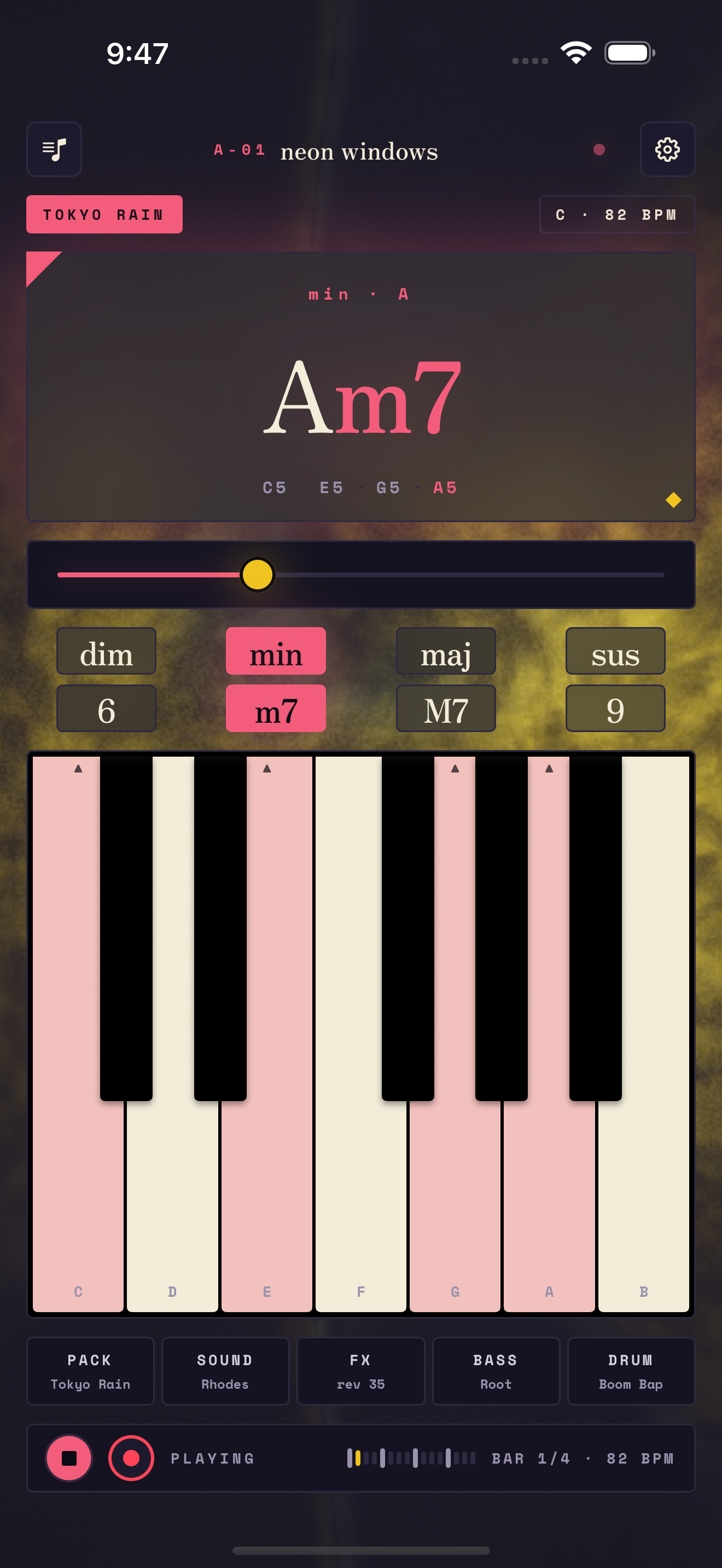
The playing screen with the transport bar showing PLAYING and the bar count
Play, then catch four bars
07Library

Keep your loops 保存

Save the current loop and it lands in your library with its pack, key and tempo remembered. Re-open one any time to keep playing, or to export it.

Everything stays on your device — no account, no cloud, no sign-in. To remove a loop, delete it in the library; to remove everything, delete the app.
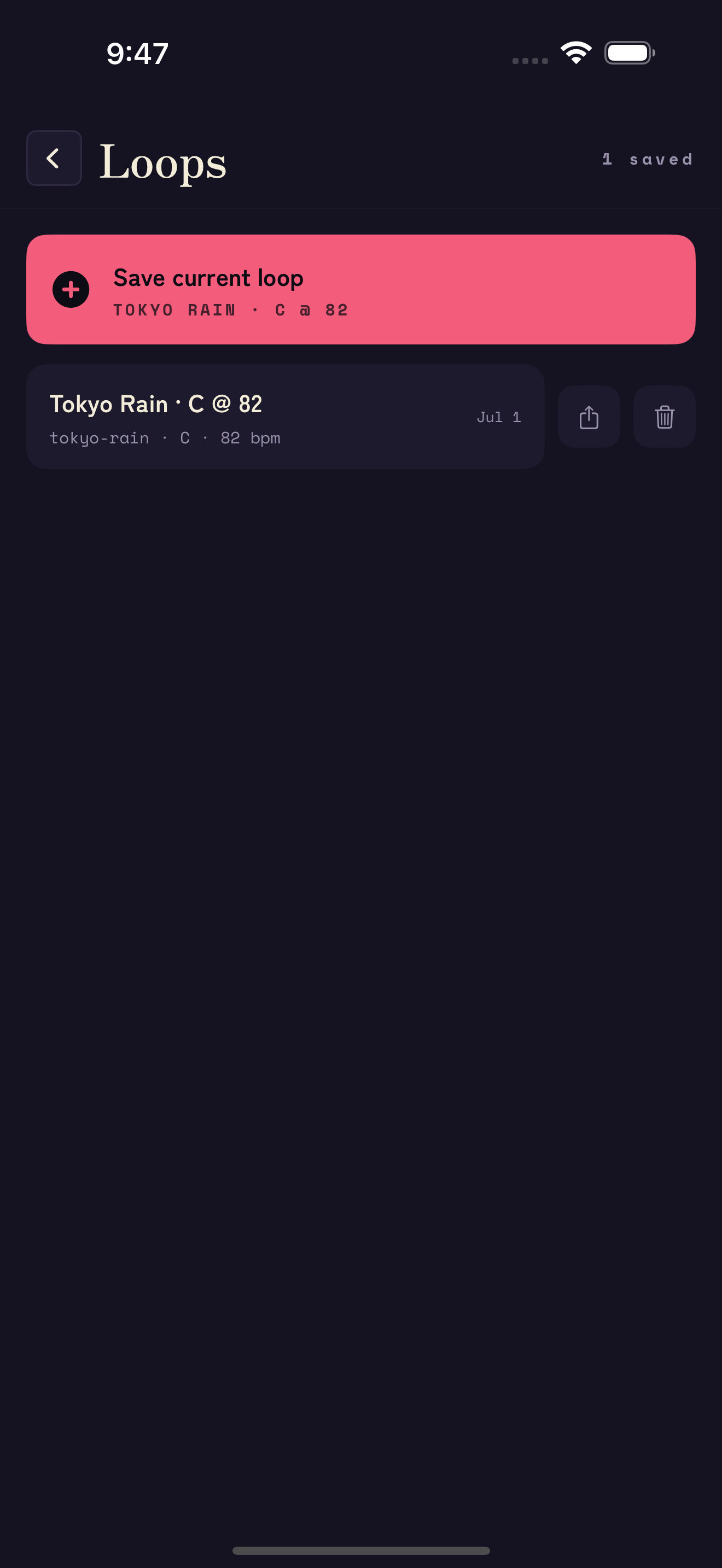
The loop library, with a saved loop showing its pack, key and tempo
Your loops, on your device
08Share

Turn it into a video 分かち合い

From a saved loop, export a video where the ink-wash background blooms with every chord. Save it straight to Photos, or send it anywhere with the share sheet.

Matcha only asks for photo-library permission at the moment you save a video — it never looks at the photos you already have.

On the Lock Screen

While a loop plays, your jam appears as a Live Activity on the Lock Screen and in the Dynamic Island — pack, key and tempo at a glance.

09Studio

Matcha Studio 工房

Studio is one purchase — no subscription, no account — and it unlocks the half of Matcha that keeps what you play. You can hear all of it first: the hub plays a built-in demo song, and Magic will arrange your own bars as many times as you like before you decide.

Open it from STUDIO in the top bar, or from Settings.

  1. Matcha Magic — pick a mood and it lays out an intro, verses, a lift and an outro from your four bars. Regenerate for another take; each one plays in full.
  2. Song Mode — reorder, duplicate and rename sections, set how hard each hits, swap the loop underneath. Playback crosses sections without a gap.
  3. Chord Journey — three directions from wherever you are: stay chill, add tension, take me home. The row sits under the chord card.
  4. Signature Packs — Rainy Taipei, Dusty Cassette, Bedroom R&B, Night Train.
  5. Recording and Pro Export — catch four bars, then export a MIDI file (chords, bass and GM drums on their own channels), audio stems, or the whole song.
The Matcha Studio screen with the unlock button, the demo song and the five features
Studio, before buying anything
In your DAW

Studio also enables the AUv3 instrument. In GarageBand, Logic, AUM or Cubasis, add Matcha: Chord Synth — the same voices and packs, played from your host. Open Matcha on the device once after buying so the plugin can see the unlock.

A few extras

In Settings you will find an experimental sampler, MIDI out and sync to an external clock, and a switch for the animated background. There is also a way to re-run this walkthrough inside the app whenever you like.

Matcha collects no data and works entirely offline; the Studio purchase is handled by Apple and needs no account — see the Privacy Policy. If something is not clear or not working, Support is one message away.